Training Collections
Library Memberships
On-demand course library with video lectures, expert case reviews, and more
Fellowship Certificate™ Programs
Practice-focused training programs designed to help you gain experience in a specific subspecialty area.
Ultimate Learning Pass
Unlock access to our full Course Library and all self-paced Fellowships.
Continuing Medical Education (State CME)
Complete all of your state CME requirements in one convenient place.
Noon Conference (Free)
Get access to free live lectures, every week, from top radiologists.
Case of the Week (Free)
Get a free weekly case delivered right to your inbox.
Case Crunch: Rapid Case Review (Free)
Register for free live board reviews.
Dr. Resnick's MSK Conference
Learn directly from the MSK Master himself.
Lower Extremities MRI Conference
Musculoskeletal Imaging
For Training Programs
Supplement your training program with case-based learning for residents, registrars, fellows, and more.
For Private Practices
Upskill in high growth, advanced imaging areas.
Compliance
NewTrack, fulfill, and report on all your radiologists' credentialing and licensing requirements.
Emergency Call Prep
Prepare trainees to be on call for the emergency department with this specialized training series.
Training Collections
Library Memberships
On-demand course library with video lectures, expert case reviews, and more
Fellowship Certificate™ Programs
Practice-focused training programs designed to help you gain experience in a specific subspecialty area.
Ultimate Learning Pass
Unlock access to our full Course Library and all self-paced Fellowships.
Continuing Medical Education (State CME)
Complete all of your state CME requirements in one convenient place.
Noon Conference (Free)
Get access to free live lectures, every week, from top radiologists.
Case of the Week (Free)
Get a free weekly case delivered right to your inbox.
Case Crunch: Rapid Case Review (Free)
Register for free live board reviews.
Dr. Resnick's MSK Conference
Learn directly from the MSK Master himself.
Lower Extremities MRI Conference
Musculoskeletal Imaging
For Training Programs
Supplement your training program with case-based learning for residents, registrars, fellows, and more.
For Private Practices
Upskill in high growth, advanced imaging areas.
Compliance
NewTrack, fulfill, and report on all your radiologists' credentialing and licensing requirements.
Emergency Call Prep
Prepare trainees to be on call for the emergency department with this specialized training series.
Lesson
Oral Cavity Anatomy
7 topics, 29 min. of video
Lesson
Oral Cavity Staging of Squamous Cell Malignancy
18 topics, 1 hr. 26 min. of video
Principles of T Staging of Oral Cavity Squamous Cell Malignancy
4 m.Principles of N and M Staging of Oral Cavity Squamous Cell Malignancy
6 m.Diagnosis of Oral Tongue Squamous Cell Malignancy
6 m.T Staging of Oral Tongue Squamous Cell Malignancy
6 m.N and M Staging of Oral Tongue Squamous Cell Malignancy
5 m.Diagnosis of Buccal Mucosal Squamous Cell Malignancy
4 m.T Staging of Buccal Mucosal Squamous Cell Malignancy
3 m.N and M Staging of Buccal Mucosal Squamous Cell Malignancy
3 m.Diagnosis of Alveolar Mucosal Squamous Cell Malignancy
7 m.T Staging of Alveolar Mucosal Squamous Cell Malignancy
6 m.Diagnosis of Retromolar Trigone Squamous Cell Malignancy
6 m.T Staging of Retromolar Trigone Squamous Cell Malignancy
5 m.Diagnosis of Hard Palate Squamous Cell Malignancy
4 m.T Staging of Hard Palate Squamous Cell Malignancy
4 m.Diagnosis of Floor of Mouth Squamous Cell Malignancy
9 m.T Staging of Floor of Mouth Squamous Cell Malignancy
6 m.N and M Staging of Floor of Mouth Squamous Cell Malignancy
5 m.Marrow Infiltration and Perineural Infiltration in the Oral Cavity
5 m.Lesson
Lymph Node Levels of the Neck
7 topics, 24 min. of video
Lesson
Oropharynx
21 topics, 1 hr. 9 min. of video
Anatomy and Boundaries of the Oropharynx
4 m.Anatomy of the Tongue Base
4 m.Anatomy of the Palatine Tonsil
4 m.Anatomy of the Soft Palate
3 m.Anatomy of the Posterior Oropharyngeal Wall
3 m.Oropharyngeal SCC of the Base of Tongue
4 m.Oropharyngeal Carcinoma: Nodal Drainage and Differential Dx
5 m.Staging Oropharynx Cancer, T-staging
4 m.Staging Oropharynx Cancer, N-Staging
6 m.Oropharynx - Base of Tongue SCC: T-Staging
3 m.Base of Tongue Oropharyngeal Carcinoma, N & M Staging
3 m.Oropharynx - SCC of the Palatine Tonsil
4 m.Oropharynx - Palatine Tonsil SCC: Paths of Spread
5 m.Oropharynx - Lymphadenopathy and HPV-Related SCC
3 m.Oropharynx - Palatine Tonsil SCC - T Staging
4 m.Oropharynx - Palatine Tonsil SCC - N/M Staging
4 m.Oropharynx - SCC of the Soft Palate
3 m.Oropharynx - SCC: Paths of Spread and Differential Dx
4 m.Oropharynx - Soft Palate SCC: Nodal Drainage
2 m.Oropharynx - Soft Palate SCC - TNM Staging
3 m.Oropharynx - Base of Tongue Mucoepidermoid Carcinoma
5 m.Lesson
Hypopharynx
18 topics, 56 min. of video
Hypopharynx anatomy
4 m.Hypopharynx - The Piriform Sinus Anatomy
5 m.Hypopharynx - The Postcricoid Space Anatomy
4 m.Hypopharynx - The Posterior Hypopharyngeal Wall Anatomy
5 m.Hypopharynx - Piriform Sinus SCC
5 m.Hypopharynx - Piriform Sinus Carcinoma - Local Spread
4 m.Hypopharyngeal SCC - Nodal Drainage
3 m.Hypopharyngeal SCC - Differential Dx
2 m.Hypopharyngeal Carcinoma - T Staging
3 m.Hypopharyngeal SCC - N Staging
3 m.Hypopharynx - Piriform Sinus SCC - T Staging
5 m.Hypopharynx - Piriform Sinus SCC - N/M Staging
4 m.Hypopharynx - Postcricoid Space SCC
4 m.Hypopharynx - Postcricoid Space SCC - Local Spread
4 m.Hypopharynx - Postcricoid SCC - Differential Diagnoses
2 m.Hypopharynx - Postcricoid Space SCC: T Staging
3 m.Hypopharynx - Postcricoid Space SCC - N/M Staging
3 m.Hypopharynx - Changes in AJCC Staging Guidelines
4 m.Lesson
Larynx
18 topics, 1 hr. 3 min. of video
Larynx Anatomy
5 m.Larynx Anatomy: Supraglottic, Glottic, and Subglottic Sites
9 m.The Supraglottic Larynx
4 m.The Glottic Larynx.
3 m.The Subglottic Larynx
3 m.Laryngeal SCC - T Staging
7 m.Laryngeal SCC - Cartilage Invasion
4 m.Laryngeal SCC: Local and Nodal Extension
4 m.Supraglottic SCC- Differential Diagnoses
3 m.Laryngeal SCC: Glottic Origin
5 m.Larynx - Glottic SCC: Patterns of Local Spread
4 m.Laryngeal SCC of the Subglottis
3 m.Larynx - Subglottic Carcinomas: Patterns of Spread & Differential Dx
3 m.Laryngeal SCC: T Staging
4 m.Larynx - Glottic SCC: T Staging
3 m.Laryngeal SCC: N Staging
2 m.Glottic SCC: T Staging
4 m.Laryngeal SCC: N and M Staging
3 m.Lesson
Sinonasal
5 topics, 14 min. of video
Lesson
Perineural Tumor Spread
3 topics, 16 min. of video
0:01
Hello everyone.
0:02
Dr. Sidney Levy here, I'm continuing our
0:05
discussion of the diagnosis and staging of
0:07
oropharyngeal squamous cell malignancy, and
0:10
would now like to focus on the soft palate.
0:15
So soft palate tumors tend to be less common
0:17
than palatine tonsillar tumors, and can often be
0:22
difficult to appreciate in the axial plane, so it's
0:24
important to make use of orthogonal projections.
0:28
In this particular case, our sample tumor
0:31
is best appreciated in the coronal plane.
0:35
It's important to look for asymmetry of
0:38
the soft palate, because these tumors tend
0:41
to be infiltrative, sometimes ulcerated.
0:46
And sometimes the only clue you will get
0:48
is a diffuse asymmetric thickening or mass
0:51
like appearance of one of the soft palates.
0:55
So I'd like to, uh, use this case example where I
0:58
have pre-contrast T1-weighted imaging without fat
1:01
suppression, pre-contrast T2-weighted imaging with
1:04
fat suppression, and post-contrast T1-weighted imaging
1:08
with fat suppression on the right in the coronal plane.
1:13
I will draw the tumor for you.
1:15
The coronal plane demonstrates it most easily.
1:19
It is an asymmetric mass-like
1:21
thickening of the left soft palate.
1:25
It is easy to mistake these tumors
1:27
for palatine tonsillar tumors, and
1:30
a helpful landmark can be the uvula.
1:32
On T1-weighted imaging, they are often
1:37
iso-intense to adjacent
1:40
muscle, sometimes hypointense, or slightly
1:45
hypointense to normal soft palate mucosa.
1:50
In this case, not so.
1:52
On T2-weighted imaging, they are hyperintense
1:56
tumors, and you can always compare that with normal
1:59
soft palate, which will be less hyperintense.
2:03
So in this case, this is a normal soft palate.
2:07
This is the tumor, and you can see that the T2
2:10
signal intensity is increased on the left-hand side.
2:14
On post-contrast imaging, they usually demonstrate
2:17
either focal or diffuse moderate enhancement.
2:20
In this case, it is reasonably focal.
2:23
In our next vignette, we will discuss the
2:25
patterns of spread of these tumors, and then
2:28
go on to discuss patterns of nodal drainage.
Oropharynx - SCC of the Soft Palate
HIDEInteractive Transcript
0:01
Hello everyone.
0:02
Dr. Sidney Levy here, I'm continuing our
0:05
discussion of the diagnosis and staging of
0:07
oropharyngeal squamous cell malignancy, and
0:10
would now like to focus on the soft palate.
0:15
So soft palate tumors tend to be less common
0:17
than palatine tonsillar tumors, and can often be
0:22
difficult to appreciate in the axial plane, so it's
0:24
important to make use of orthogonal projections.
0:28
In this particular case, our sample tumor
0:31
is best appreciated in the coronal plane.
0:35
It's important to look for asymmetry of
0:38
the soft palate, because these tumors tend
0:41
to be infiltrative, sometimes ulcerated.
0:46
And sometimes the only clue you will get
0:48
is a diffuse asymmetric thickening or mass
0:51
like appearance of one of the soft palates.
0:55
So I'd like to, uh, use this case example where I
0:58
have pre-contrast T1-weighted imaging without fat
1:01
suppression, pre-contrast T2-weighted imaging with
1:04
fat suppression, and post-contrast T1-weighted imaging
1:08
with fat suppression on the right in the coronal plane.
1:13
I will draw the tumor for you.
1:15
The coronal plane demonstrates it most easily.
1:19
It is an asymmetric mass-like
1:21
thickening of the left soft palate.
1:25
It is easy to mistake these tumors
1:27
for palatine tonsillar tumors, and
1:30
a helpful landmark can be the uvula.
1:32
On T1-weighted imaging, they are often
1:37
iso-intense to adjacent
1:40
muscle, sometimes hypointense, or slightly
1:45
hypointense to normal soft palate mucosa.
1:50
In this case, not so.
1:52
On T2-weighted imaging, they are hyperintense
1:56
tumors, and you can always compare that with normal
1:59
soft palate, which will be less hyperintense.
2:03
So in this case, this is a normal soft palate.
2:07
This is the tumor, and you can see that the T2
2:10
signal intensity is increased on the left-hand side.
2:14
On post-contrast imaging, they usually demonstrate
2:17
either focal or diffuse moderate enhancement.
2:20
In this case, it is reasonably focal.
2:23
In our next vignette, we will discuss the
2:25
patterns of spread of these tumors, and then
2:28
go on to discuss patterns of nodal drainage.
Report
Description
Faculty
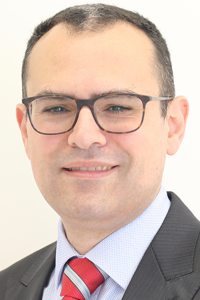
Sidney Levy, PhD, MBBS
Radiologist and Nuclear Medicine Specialist
I-MED
Tags
Oral Cavity/Oropharynx
Neuroradiology
Neuro
Neoplastic
MRI
Head and Neck
© 2026 Medality. All Rights Reserved.
