Training Collections
Library Memberships
On-demand course library with video lectures, expert case reviews, and more
Fellowship Certificate™ Programs
Practice-focused training programs designed to help you gain experience in a specific subspecialty area.
Ultimate Learning Pass
Unlock access to our full Course Library and all self-paced Fellowships.
Continuing Medical Education (State CME)
Complete all of your state CME requirements in one convenient place.
Noon Conference (Free)
Get access to free live lectures, every week, from top radiologists.
Case of the Week (Free)
Get a free weekly case delivered right to your inbox.
Case Crunch: Rapid Case Review (Free)
Register for free live board reviews.
Dr. Resnick's MSK Conference
Learn directly from the MSK Master himself.
Lower Extremities MRI Conference
Musculoskeletal Imaging
Emergency Imaging
Emergency GI & Abdominal Radiology FellowshipNEW!
PET Imaging
Pediatric Imaging
For Training Programs
Supplement your training program with case-based learning for residents, registrars, fellows, and more.
For Private Practices
Upskill in high growth, advanced imaging areas.
Compliance
NewTrack, fulfill, and report on all your radiologists' credentialing and licensing requirements.
Emergency Call Prep
Prepare trainees to be on call for the emergency department with this specialized training series.
Lesson
Vascular Ultrasound
2 topics, 11 min. of video
Lesson
Carotid Ultrasound
10 topics, 22 min. of video
Lesson
Liver Doppler
7 topics, 17 min. of video
Lesson
Renal Artery Stenosis
2 topics, 3 min. of video
Lesson
Mesenteric Doppler
3 topics, 9 min. of video
Inferior Vena Cava (IVC)
Inferior Vena Cava (IVC)
3 topics, 8 min. of video
Lesson
Aorta Anatomy
2 topics, 3 min. of video
Lesson
Conclusion
1 topic, 1 min. of video
0:00
That concludes our course in vascular ultrasound.
0:02
Thank you for your interest, attention, and engagement throughout the lectures.
0:06
Over the course of the series, we've covered a tremendous amount of material from
0:09
head to toe. We began with the fundamentals of Doppler physics, hemodynamics,
0:13
waveform analysis, and the principles that form the foundation of vascular
0:16
ultrasound. From there, we explored vascular imaging throughout the body, including
0:20
carotid arteries, abdominal vasculature, liver, kidneys, and lower extremity
0:24
arterial and venous systems. My hope is that this has provided you with a practical
0:28
framework to better understand and interpret these ultrasound studies in your daily
0:32
practice. If there's one key takeaway I'd like you to remember, it's this: focus on
0:36
the underlying physics and the hemodynamic principles behind what creates a
0:40
waveform and how that waveform changes in the presence of disease.
0:43
And really, once you understand those concepts, you can apply them anywhere in the
0:47
vascular system rather than relying on memorization of individual exams or
0:51
individual diagnostic criteria.
0:53
This is ultimately a study of blood flow, and those same fundamental principles are
0:58
repeated throughout the body. And so when you understand those, you'll be able to
1:01
understand and approach new and unfamiliar problems with that same degree of
1:05
confidence. So thank you again for participating.
1:07
I wish you the best in your continued learning and practice of vascular ultrasound.
Take Home Points
HIDEInteractive Transcript
0:00
That concludes our course in vascular ultrasound.
0:02
Thank you for your interest, attention, and engagement throughout the lectures.
0:06
Over the course of the series, we've covered a tremendous amount of material from
0:09
head to toe. We began with the fundamentals of Doppler physics, hemodynamics,
0:13
waveform analysis, and the principles that form the foundation of vascular
0:16
ultrasound. From there, we explored vascular imaging throughout the body, including
0:20
carotid arteries, abdominal vasculature, liver, kidneys, and lower extremity
0:24
arterial and venous systems. My hope is that this has provided you with a practical
0:28
framework to better understand and interpret these ultrasound studies in your daily
0:32
practice. If there's one key takeaway I'd like you to remember, it's this: focus on
0:36
the underlying physics and the hemodynamic principles behind what creates a
0:40
waveform and how that waveform changes in the presence of disease.
0:43
And really, once you understand those concepts, you can apply them anywhere in the
0:47
vascular system rather than relying on memorization of individual exams or
0:51
individual diagnostic criteria.
0:53
This is ultimately a study of blood flow, and those same fundamental principles are
0:58
repeated throughout the body. And so when you understand those, you'll be able to
1:01
understand and approach new and unfamiliar problems with that same degree of
1:05
confidence. So thank you again for participating.
1:07
I wish you the best in your continued learning and practice of vascular ultrasound.
Report
Faculty
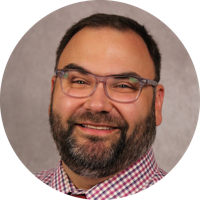
Constantine M. Burgan, MD
Professor, Abdominal Radiology
University of Alabama at Birmingham
Tags
Vascular Imaging
Vascular
Ultrasound
© 2026 Medality. All Rights Reserved.
