Every radiology resident hits the same wall. You can recite the differential for a ring-enhancing lesion, then freeze when a real stack loads on PACS at 2 a.m. Textbooks teach you what a finding is. Scenario cases teach you how to find it, and what to do when it doesn’t perfectly match the textbook.
Case-based learning closes that gap. Instead of starting from a topic, you start from an image, scroll the study, or commit to a read, then check your answer against an expert’s interpretation. Done consistently, it builds the skills radiology residency actually asks of you: a reliable search pattern, fast pattern recognition, and a confident report.
Here’s what the evidence says about why it works, and how to choose case-based learning resources that make the most of your limited study time.
1. It Builds Search Patterns and Pattern Recognition
Radiology is as much about seeing as it is about knowing. You can’t spot a subtle finding you’ve never seen, and you won’t see it if your eyes skip that part of the image. Both improve with deliberate exposure to many cases.
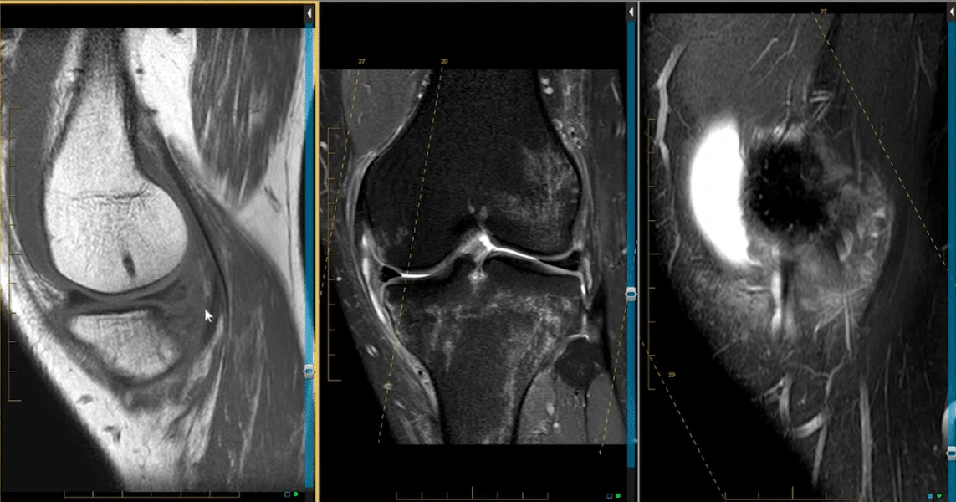
The research backs this up. In a study of a guided MRI case review program at Indiana University School of Medicine, 25 first- and second-year residents worked through knee and shoulder MRI cases with built-in teaching and immediate feedback. They averaged about 29 knee and 17 shoulder cases over a four-week rotation. Their search pattern scores rose significantly from baseline, and they outscored untrained third-year residents who were a full year further along.
The point isn’t just volume. Structured cases with feedback teach you a systematic way through each study, so you check the meniscal roots or the lung apices every time, not just when you remember to.
2. Committing to an Answer Makes Knowledge Stick
Rereading notes feels productive, but it’s one of the weakest ways to learn. Retrieval practice, which means pulling an answer from memory before you see it, is one of the strongest.
In a randomized controlled trial with medical residents, those who took repeated tests on conference material remembered substantially more six months later than those who repeatedly studied the same content.
A good case is retrieval practice by design. You look at the images, form a finding and a differential, and only then see the answer. Every miss is a memorable correction. Cases you get wrong tend to be the ones you never forget.
3. It Prepares You for Independent Call
On call, nobody hands you a topic heading. You get an indication, a stack of images, and a clinician waiting on your preliminary read. Case-based learning rehearses exactly that situation.
Experience pays off here. A UT Southwestern review of 416,413 studies read independently by residents at a busy county hospital found a major discrepancy rate of just 1.7%. Only 0.2% of studies had a significant negative patient impact. Rates fell as residents progressed, from 1.8% in PGY-3 to 1.5% in PGY-5. Discrepancies were highest on MRI (3.7%) and CT (2.4%).
You can’t schedule real emergencies, but you can practice on them. Working through high-acuity cases before your first call shifts, especially cross-sectional ones, means you’ve seen the can’t-miss findings before they matter.
4. It Matches How the Boards Test You
The American Board of Radiology describes its diagnostic radiology qualifying and certifying exams as “image-rich”. Questions can include static images, scrollable image series and short video clips.
The ABR has also announced an exam platform designed to work like a simplified PACS. It lets examinees view up to six series at once and enlarge, pan, and adjust contrast, much like a real workstation.
As the exam moves closer to real image review, so should your prep. Scrolling through full cases builds the same habits the test now rewards, and memorizing single key images doesn’t.
How to Choose Case-Based Learning Radiology Resources
Not every case collection is built for learning. When you compare case-based learning radiology resources for residents, look for:
- Full, scrollable studies. Real DICOM stacks, not single key images. That’s how you read on call, and increasingly how the boards test you.
- Mimic a real workstation. You should be able to form your own read before the answer appears.
- Expert explanations. A walkthrough of the search pattern and differential, not just the diagnosis.
- Coverage that grows with you. Fundamentals for junior residents and higher-complexity cases for seniors, across all subspecialties.
- Call-relevant and board-aligned content. Emergency cases for call readiness, and cases mapped to the ABR Core Exam blueprint for boards.
A few habits help too. Do a short block of cases most days instead of cramming. Review your misses a week later. And match your case work to your current rotation so it reinforces what you’re seeing in the reading room.
Start Building Your Case Volume with Medality
Medality’s training resources for radiology residents are built around real cases. You can start for free:
- Fundamentals Collections are tailored learning paths for junior (Level 1) and senior (Level 2) residents across every subspecialty.
- Case Crunch: Rapid Case Review offers 10 one-hour case reviews on high-yield topics from the ABR Core Exam blueprint.
- Case of the Week delivers scrollable DICOM cases with expert video explanations.
- Noon Conference brings live-streamed lectures every week at 12 p.m. ET.
If you want more depth, Premium Membership includes 4,000+ high-yield cases, 500+ expert case reviews and 500+ case quizzes. The DXIT™/Core SmartBank adds 1,000+ board-style practice questions in an interactive image viewer, and Emergency Call Prep focuses on on-call readiness.
Explore Medality’s free resources for radiology residents →
FAQs
What is case-based learning in radiology? It’s learning anchored in real imaging cases. You review a study, commit to findings and a differential, then compare your read with an expert’s interpretation and explanation.
Why is case-based learning effective for radiology residents? It trains perception and recall together. Guided case review with feedback has been shown to improve residents’ search patterns, and retrieval practice improves long-term retention compared with rereading.
How many cases should a radiology resident review? There’s no single magic number. Consistency matters more than volume: a short daily block of cases, with a later review of the ones you missed, beats occasional marathon sessions.
Does case-based learning help with the ABR Core Exam? Yes. The ABR’s diagnostic radiology exams are image-rich and can include scrollable image series, so practicing on full cases builds the skills the exam tests.
What are the best case-based learning resources for radiology residents? Look for full scrollable studies, a commit-first format, expert explanations, coverage for junior and senior levels, and content aligned to call and the ABR Core Exam blueprint. Medality offers free options, including Case of the Week and Case Crunch.