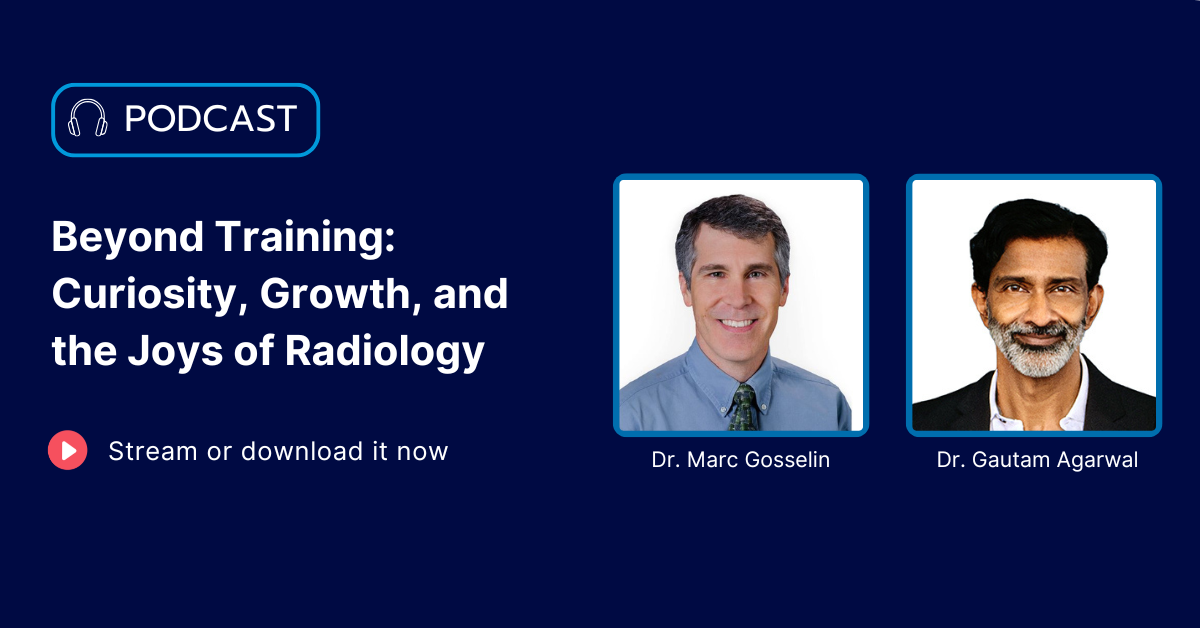
What makes a great radiologist? Is it the residency program? The fellowship pedigree? The hospital name on the badge?
According to Dr. Marc Gosselin, the answer is much simpler:
“The residency doesn’t make you good. You make yourself good.”
In the inaugural episode of The Joys of Radiology, Dr. Gautam Agarwal sits down with renowned radiologist, educator, and mentor Dr. Marc Gosselin for a wide-ranging conversation on radiology training, physician burnout, medical education, mentorship, career growth, and lifelong learning in medicine.
This episode offers valuable insight for medical students, radiology residents, fellows, practicing radiologists, and healthcare professionals looking to build meaningful and sustainable careers.
How Dr. Marc Gosselin Chose Radiology
Like many medical students, Dr. Gosselin entered training interested in multiple specialties. During his rotations at McGill University, he discovered that radiology uniquely combined broad medical knowledge with deep intellectual challenge.
He described radiology as: “The family practice of subspecialties.” Radiology allowed him to think across organ systems, solve diagnostic puzzles, and directly understand what was happening inside the patient.
That perspective remains highly relevant today for anyone asking:
- Why choose radiology?
- Is radiology a good specialty?
- What makes radiology rewarding?
For Dr. Gosselin, the answer was curiosity.
Great Radiologists Learn to Truly See
One of the most powerful themes from the conversation was the distinction between memorizing patterns and learning to truly observe.
Dr. Gosselin explained that early in training, many physicians look for what they were taught to see. With experience, they begin noticing when imaging findings do not match the expected pattern and that is where deeper learning begins.
This is a crucial lesson for radiology education. Strong radiologists do not just recognize findings. They question findings. That mindset helps physicians:
- Improve diagnostic accuracy
- Avoid cognitive bias
- Think independently
- Continue growing long after residency
Why the First Two Years After Fellowship Matter Most
Many trainees assume the hardest learning happens during residency or fellowship. Dr. Gosselin offered a different perspective. He described the first two years as an attending radiologist as the most transformative phase of professional growth. Why? Because that is when physicians:
- Make independent decisions
- Face uncertainty directly
- Learn from mistakes
- Build confidence
- Develop their personal style of practice
His advice? "Choose your first job carefully." Find a practice where you can:
- Ask questions
- Receive feedback
- Learn from colleagues
- Review outcomes
- Continue evolving
This applies whether the practice is academic, private, or teleradiology.
Physician Burnout in Radiology: What Really Causes It?
One of the most insightful parts of the discussion focused on radiologist burnout. Dr. Gosselin explained that burnout is not always just about working hard. Often, it comes from something deeper: losing connection to purpose. He described modern medicine as creating:
- Isolation
- High-volume output pressure
- Reduced clinician interaction
- Constant productivity metrics
- Less appreciation
- Less meaningful collaboration
When work becomes pure throughput, fulfillment declines.
Preventing Burnout Requires More Than Time Off
Sustainable careers require:
- Meaningful work
- Collegial relationships
- Professional autonomy
- Ongoing learning
- Feeling valued
- Connection to patient care
For radiologists and physicians alike, these factors matter enormously.
Does Teleradiology Reduce Education?
A common assumption is that new graduates need only in-person jobs to learn effectively. Dr. Gosselin challenged that belief. He explained that education depends less on physical location and more on access to engaged colleagues, communication, mentorship, and feedback systems. That means strong learning environments can exist in:
- Academic hospitals
- Private groups
- Hybrid practices
- Remote radiology teams
- Teleradiology models with active collaboration
The key is not where you sit. The key is whether you keep learning.
Career Advice for Medical Students and Residents
For trainees trying to choose a specialty, residency, or career path, Dr. Gosselin emphasized something many people overlook: Know yourself.
Instead of chasing prestige, rankings, or outside expectations, pay attention to how you feel after clinical rotations and workdays. Ask yourself:
- What energizes me?
- What drains me?
- Where do I feel curious?
- Where do I feel engaged?
- What kind of life do I want outside work?
That self-awareness often leads to better long-term career decisions than reputation alone.
Why Mentorship Still Matters in Medicine
Throughout the episode, Dr. Agarwal highlights Dr. Gosselin’s extraordinary impact as an educator. Great mentors do more than teach facts. They:
- Create confidence
- Inspire curiosity
- Challenge assumptions
- Encourage humility
- Model lifelong learning
In medicine, mentorship often becomes the difference between surviving training and thriving in practice.
Final Takeaway: You Build Your Own Greatness
The central lesson of this episode is powerful. Your training matters. Environment matters. Mentors matter. But ultimately, you are responsible for your own growth. Not your residency name. Not your fellowship pedigree. Not your employer. But it is your curiosity, humility, discipline, and willingness to keep learning determine your future.
As Dr. Gosselin says: “The residency doesn’t make you good. You make yourself good.”
About Dr. Marc Gosselin
Dr. Gosselin completed medical school at McGill University, followed by a Radiology Residency at the University of Vermont. He then pursued a Fellowship in Cardiopulmonary Imaging at Stanford University.
He served on the faculty at the University of Utah, where he was the head of Chest Imaging from 1997 to 2001, and also directed both the Radiology and Medical Student Program. He continued his illustrious career at Oregon Health & Science University (OHSU), leading the Cardiopulmonary Imaging Division and the Radiology Program for medical students from 2001 to 2016.
Currently, he is a faculty member at Vision Radiology, where he continues to contribute to the field of medical imaging.